Description of the United States of North America
The EmigrantsDescription of the United States of North America is the guidebook through which Robert Nilsson first makes America legible from afar. Hidden beneath his bed and read until its principal chapters are nearly memorized, it becomes both a private resource and a means of persuasion: Robert uses its information to draw Arvid toward emigration and to imagine a society unlike the one that has confined their prospects in Sweden. The book’s influence is powerful, but not uncontested; its promises travel farther than the evidence the emigrants can verify for themselves.
Acquisition and Use
Robert asked Rinaldo, the schoolmaster at Nybacken, for a truthful description of North America. Rinaldo had seen a notice in the newspaper Barometern advertising a book for forty-eight shillings, or one riksdaler, postage included. He ordered it and advanced the cost until Robert could pay from his wages. His willingness to help reflected Robert’s unusual appetite for reading: he was the schoolmaster’s only pupil who chose books for himself.
The book became Robert’s concealed tutor. He read it from cover to cover three times during the summer nights in his room, and knew its most important chapters almost by heart. Its title promised a description for ordinary, uneducated people who intended to emigrate. Robert first kept this knowledge to himself; when his younger companion disclosed his plan to escape with a timber load and cross the ocean, Robert’s information offered a way to explain why America might be a destination for both of them.
America as the Book Describes It
The guide presents its claims as unusually trustworthy. Its opening assures readers that material which might seem unbelievable or exaggerated is nonetheless honest truth, with nothing changed, added, or fabricated. That declaration matters in a novel where distance makes firsthand verification impossible: Robert can cite a printed account as more than rumor, even though the book’s assurances are themselves still only words on a page.
As Robert retells its contents to Arvid, the volume counters hostile descriptions of the United States. Some Swedish members of the ruling classes, including a lieutenant in Kråkesjö, depict America as a refuge for criminals and as a place whose heat would be unendurable to people from the Old World. Robert’s account rejects these warnings, describing Americans as upright, helpful, generous, clean, and moral, while allowing that, as anywhere, an occasional wrongdoer exists. It also insists that people from Europe can breathe the air, eat the food, and drink the water there.
The guide’s most consequential promise is social as well as practical. Robert says America has no hereditary precedence dividing gentry from ordinary people: emperors and kings are forbidden, no one needs to bow or curtsy to a master, and people are not despised for doing dirty or low-status work. Farming is presented as labor shared even by a wealthy landowner, rather than work reserved for hired hands. The book further claims that America has no servant law or earnest money binding workers to service; farmhands and maids may leave when they choose, and the working day does not exceed twelve hours. For Robert and Arvid, whose prospects are shaped by employment and social rank, these claims make the book an argument for escape as much as a description of a country.
From Reading to a Shared Plan
Robert’s account helps transform his private reading into information Arvid can use. He tells the larger farmhand what the book says; Arvid listens, having known nothing of the thoughts Robert had developed since taking the wrong road at the mill creek on his way to service. The guide therefore links two different dispositions: Robert’s bookish imagination and Arvid’s attention to the practical possibility of leaving. Robert’s conviction that America is the right land for both of them grows out of repeated reading, not firsthand experience.
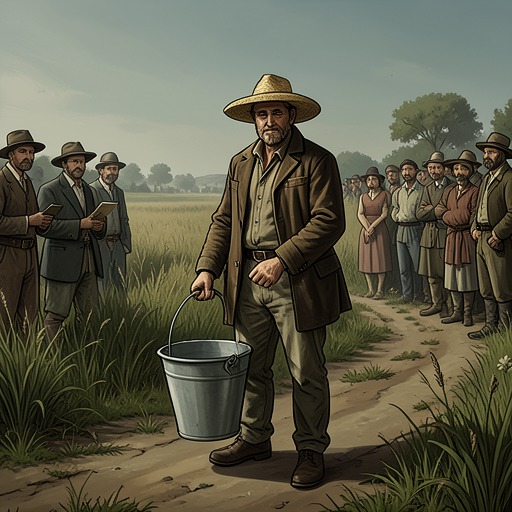
The wider emigrant group is not moved by a single cause. Its members face crop failure, official persecution, religious dissent, personal troubles, social ostracism, or unjust employment practices. Robert’s guide gives one strand of that varied movement a particular form: it supplies a picture of a New World that appears to answer the constraints of the Old. In the broader circulation of migration news, printed information joins rumors and neighbor-to-neighbor reports, helping an unfamiliar destination acquire the force of a possible choice.
Promises Tested by Departure
The book’s confident image does not resolve the uncertainties facing the emigrants. When Karl Oskar Nilsson argues for taking his household to America, Kristina Johansdotter asks what they can rely on: no American authority has promised them land, they possess no deed awaiting them, and they know no farmer with a family who has made the journey and can report from experience. She does not trust the printed words of newspapers and books as a substitute for a reliable witness. Her objection exposes the gap between the guide’s declaration of truth and the emigrants’ lack of independent confirmation.
Nor does information remove the costs and risks of moving. Karl Oskar’s household has spent four years at Korpamoen and is several hundred riksdaler poorer than when it began; remaining there promises continuing labor without improvement. Yet after the farm sale and auction, only 1,200 daler remain after debts, and the passage for three adults and three children costs 675 daler. Karl Oskar expects land to be available at little cost, but recognizes that little money will remain for tools and cattle. His parents see the passage money as nearly half the sum needed to buy a farm. The guide’s picture of opportunity thus travels alongside the hard arithmetic of getting there.
The plan nevertheless acquires a route and a timetable. Karl Oskar and Robert write to a firm in Karlshamn and secure passage on the Charlotta, a merchant ship carrying cargo and emigrants, with a 100-daler down payment for six people. They intend to embark around the second week of April and sail directly to New York; the early spring departure is meant to leave time to reach their settlement and plant a crop before winter. These arrangements convert the imagined America represented by the guide into a costly, constrained journey, rather than proving its promises in advance.
The Guide Among the Emigrants’ Possessions
As departure approaches, knowledge and material preparation meet. The old oak clothes chest, inherited through generations and once used for family belongings at baptisms, weddings, and funerals, is brought down from the attic to serve as a packing case. The household selects tools and supplies for an uncertain destination: Karl Oskar disassembles his muzzle-loader to fit it in, Robert packs fishing gear, and Kristina must leave familiar implements such as her loom and spinning wheel because space is limited. The guide’s imagined abundance cannot tell them exactly what will be available or what they will need; packing becomes a practical response to that lack of certainty.
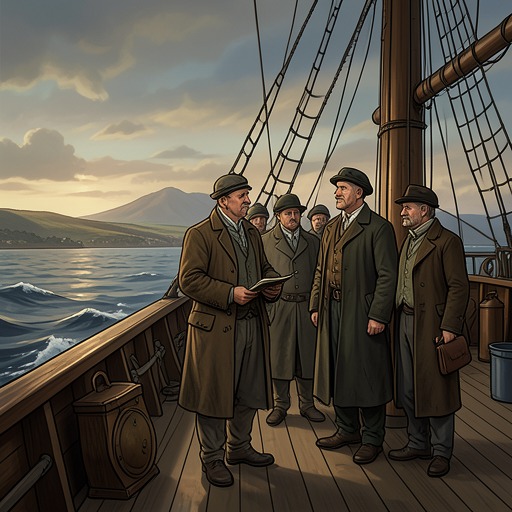
The emigrants’ crossing eventually exposes the bodily and emotional cost of the undertaking, not the easy arrival implicit in a promise of fertile land. Scurvy and ship’s fever weaken the passengers, while confinement and the monotonous voyage depress them. When America finally comes into view, the green ground they have been seeking renews their energy and ambition. The scene gives the guide’s distant destination a visible counterpart, but does not establish that its claims about land, equality, or work will prove true. Its lasting significance lies in the part it plays before the crossing: it gives Robert a language for hope and a means to persuade, while the decisions, expenses, and hardships of migration remain stubbornly concrete.